Latest News & Updates


Aluminum frames nearly every commercial curtain wall in the US. Mullions, transoms, pressure plates, brackets, and anchors all start as extrusions, so a change in import duties reaches the facade package sooner or later.
Since April 6, 2026, Section 232 duties on many aluminum products apply to the full customs value of the imported item, not just its metal content. That can raise curtain wall tariff costs on some imported assemblies, and facade packages are often bought months before the first unit goes up.
Most curtain wall tariff costs can be managed. Settle specifications early, price carefully, and write clear contract terms so tariff exposure does not turn into change orders. This article covers seven ways to do that, a budgeting method, and the mistakes that cause the most damage.
Section 232 duties cover primary aluminum and a list of derivative products. Under the April 2026 proclamation:
Where a curtain wall component lands depends on its HTSUS classification, so your rate may differ from the project next door. Pinning down that tier is the first step in estimating curtain wall tariff costs.
Several parts of a typical system can carry exposure:
Raw extrusions and finished assemblies can be classified differently, so each line item needs its own check.
Several factors affect the duty on a given component:
Exposure also reaches projects that buy from a domestic fabricator. If the fabricator imports extrusions or hardware, the duty shows up in its quote, so your curtain wall tariff costs can rise even if you never import anything yourself. Drawback is largely unavailable, so the fabricator cannot easily recover the cost.
Rates and coverage have changed several times since 2025. Confirm classification against the current HTSUS and CBP guidance, ideally with a customs broker or trade counsel. This article is general information, not legal advice.
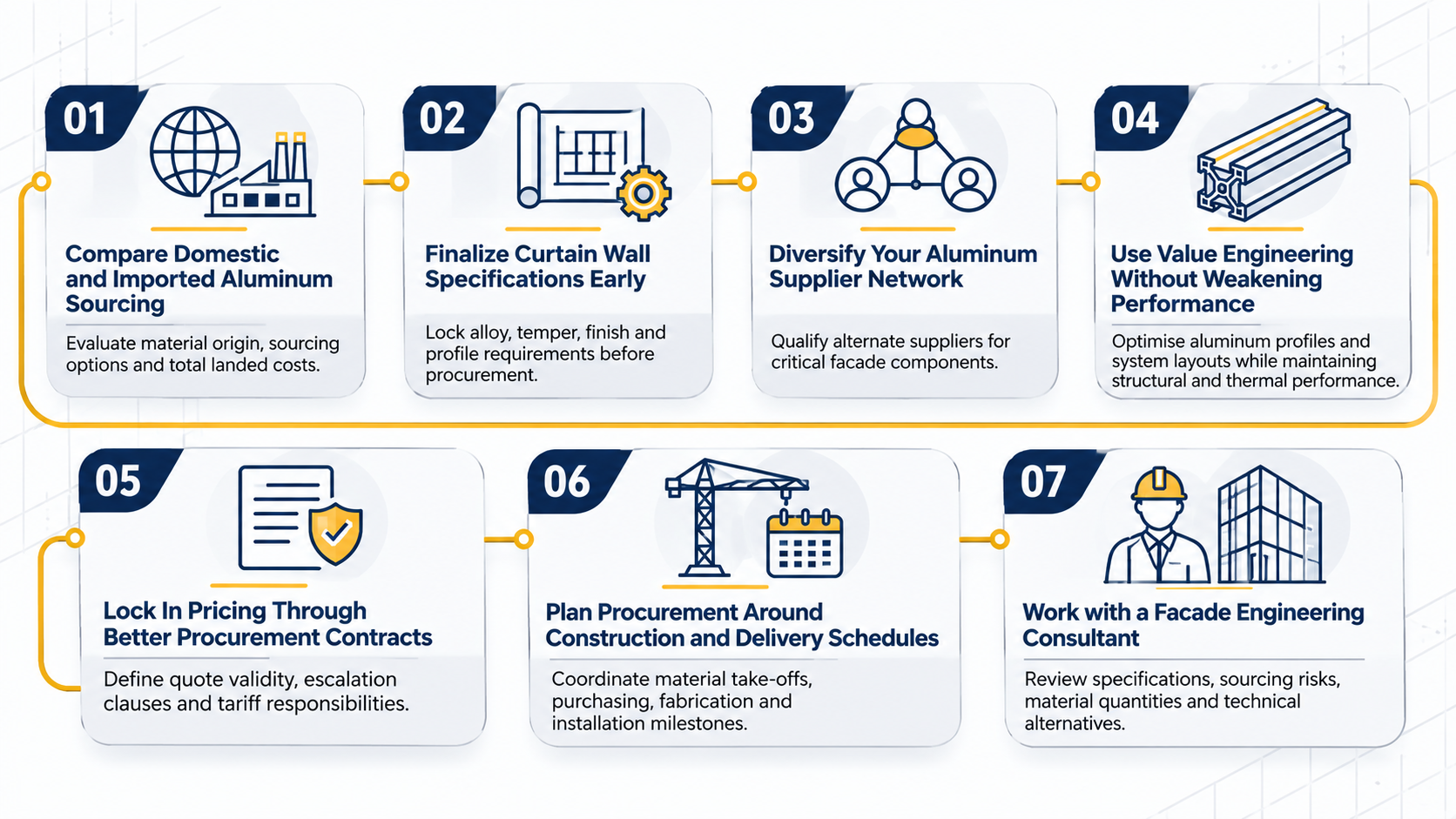
Ask every bidder to document:
These details decide the applicable duty and whether a reduced rate applies.
Domestic extrusion can lower exposure, but only if the mill meets your alloy, finish, volume, and delivery dates. Confirm capacity early, then compare total landed cost line by line:
The lowest unit price often loses once those lines are added.
The July 2026 onshoring program offers reduced rates on primary aluminum to approved smelter investors. It does not extend relief to derivative articles, so do not build a facade budget around it.
ISE’s facade consulting services in the US include reviewing supplier and sourcing options against project specifications, helping teams evaluate domestic and imported materials based on technical suitability and overall project costs.
Lock these during design development, not buyout:
A late change, such as a different finish or a deeper mullion, can force a new quote, new shop drawings, and new testing, and sometimes a different sourcing route. These choices also set how much aluminum the system uses, because profile depth and alloy decisions carry into every quantity that follows.
Bring the architect, facade engineer, and procurement team into the same conversation before tender. Name acceptable alternate materials and suppliers in the documents so bidders can switch without triggering a redesign.
Our facade design and engineering services include defining aluminum alloys, profile configurations, and finishes against project performance requirements, helping teams finalize specifications before procurement.
A single extruder or fabricator is a single point of failure. Qualify at least one alternate for critical components such as extrusions, thermal break strips, and anchors. Check each one for:
Do this before tender. Adding a supplier mid-project means new submittals and sometimes new mockup testing.
Our facade consulting services include evaluating alternate extruders and fabricators against structural, thermal, and air and water performance requirements, helping project teams qualify alternatives before procurement decisions are finalized.
Facade value engineering starts with the aluminum itself:
Consider alternate materials only after checking structural, thermal, fire, corrosion, and durability requirements. A cheaper material that fails a thermal or fire requirement costs far more to fix on site.
ISE’s facade value engineering services include reviewing profile configurations, material quantities, and system layouts to identify opportunities for material optimization while maintaining structural and thermal performance.
Fixed pricing works only if a supplier will hold it, and many will not hold it for long. Otherwise, use:
The most important clause says who carries curtain wall tariff costs that appear after signing. Define how changes in duties, customs classification, and import rules are handled, and who carries each. Without that language, the owner, general contractor, and fabricator will each assume someone else pays. A confirmed material take-off (MTO) makes these terms workable. Accurate quantities let suppliers hold a price, give the owner a basis for cost planning, and set a clear baseline for pricing any later design change.
ISE’s Material Take-off (MTO) services quantify facade profiles, panels, and hardware from design documentation, providing project teams with a reliable quantity baseline for supplier pricing and contract discussions.
A sound facade procurement strategy ties aluminum purchasing to design freeze and construction milestones:
The take-off also drives production. Extrusion orders, fabrication slots, and finishing batches all depend on firm quantities, so a late quantity change costs schedule as well as money. Weigh storage and inventory costs before ordering ahead. If any of your components fall under the Annex III reduced rate, it applies only through December 31, 2027 and rises to 25% afterward, which matters for deliveries in 2028. Avoid rushed buying when duty or supply conditions change, because rush orders add freight and premium pricing on top of curtain wall tariff costs.
Our Material Take-off (MTO) services provide detailed material quantities aligned with the facade design, helping procurement teams plan material orders, fabrication requirements, and delivery milestones.
A facade consultant can:
The value comes from timing. A change at design development costs a few drawing hours. The same change after fabrication starts costs tooling, remakes, and schedule.
ISE’s facade engineering consulting services in the US support project teams with specification reviews, system comparisons, material take-offs, and technical evaluations before design and procurement decisions are finalized.
Turn the seven strategies into a routine for tracking curtain wall tariff costs, and update it at every major milestone.
Track these lines separately so you can see where a change comes from:
Build a few scenarios for price and duty outcomes so curtain wall tariff costs carry a range, not a single guess. Then set a contingency that matches the project's actual exposure. A project buying domestic extrusions on a fixed-price quote needs less than one buying imported unitized panels. There is no universal percentage.
Review quotes and pricing assumptions at each milestone, and update the budget whenever a sourcing route or tariff classification changes.
Curtain wall tariff costs are one line in a larger equation. Material selection, structural requirements, thermal performance, fabrication efficiency, procurement planning, and installation coordination all shape the final facade budget. ISE’s facade engineering services cover material take-off, value engineering, system design, and consultancy, so project teams can evaluate systems, refine designs, and make technically sound decisions.
Planning a commercial facade project in the United States? Connect with ISE for facade engineering and consulting support, including Material Take-off (MTO), to evaluate system performance, material efficiency, and project-specific cost considerations.