Latest News & Updates

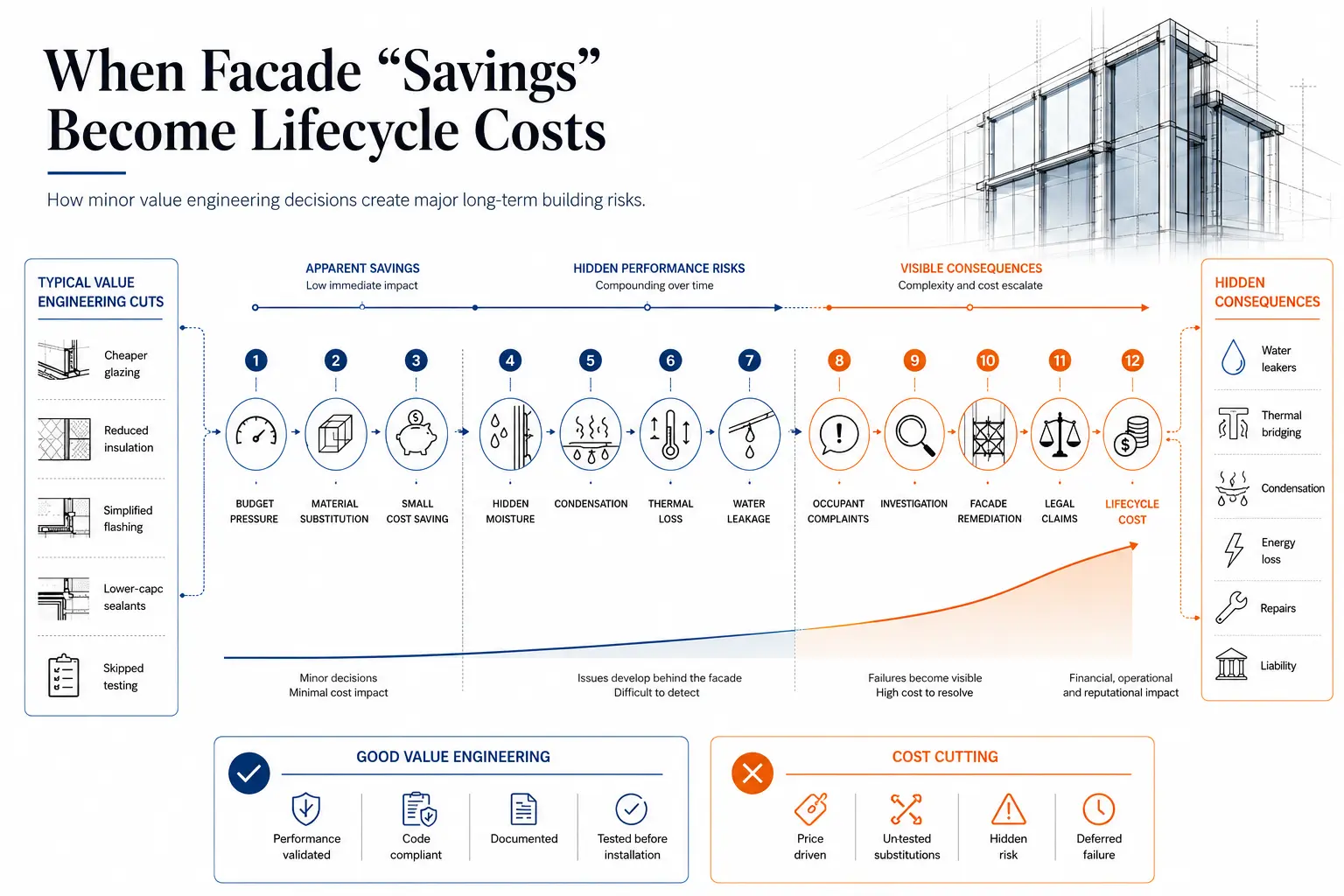
The problem is that façade value engineering is often mistaken for cost cutting.
True value engineering (VE) isn't about reducing specifications or selecting cheaper materials. It's about identifying more efficient ways to achieve the same design intent and performance requirements without compromising the building envelope.
Unlike many other building packages, façade substitutions rarely affect a single component in isolation. A change to the glazing, framing, sealants, thermal breaks, fixings, or insulation can influence how the entire façade system performs. That's why seemingly minor changes require engineering validation—not just product comparison.
Many façade components appear interchangeable.
A different glazing specification, an alternative aluminum system, or a simplified joint detail can look like a minor change with little impact on the finished building.
In reality, curtain walls and façade systems are engineered assemblies. Every component contributes to weather resistance, thermal efficiency, structural movement, durability, and occupant comfort. The issue arises when substitutions are approved based solely on upfront cost without understanding how they affect the performance of the complete façade system.
The impact of a poorly evaluated substitution isn't always immediate.
A building may be completed, occupied, and appear to perform exactly as expected. The real consequences often emerge months or even years later, once the façade has been exposed to wind, rain, thermal movement, UV exposure, and everyday operation.
Simplifying flashing details, replacing specified sealants, or selecting lower-grade gasket systems can reduce procurement costs, but it can also alter how the façade manages water.
The effects aren't always immediate.
For example, moisture can gradually enter concealed cavities before appearing as staining, corrosion, mold, or internal damage. By the time the issue becomes visible, locating the source often requires façade access systems, invasive investigations, and partial dismantling of the curtain wall or cladding.
Once the façade is complete, even a relatively minor defect can require major disruption and costly remediation.
Reducing insulation thickness, changing glazing specifications, or substituting lower-performing façade materials may reduce the initial construction cost, but they can increase the building's operating and maintenance costs throughout its lifecycle.
Reduced thermal efficiency places greater demand on HVAC systems, while lower-grade sealants, gaskets, and finishes often require replacement much earlier than specified. Maintenance on completed buildings also involves specialist access equipment, operational disruption, and significantly higher labour costs.
Instead of a one-time capital saving, the building owner inherits an ongoing operational expense.
Not all curtain wall and façade systems respond to environmental exposure in the same way.
Changes in cladding materials, aluminium framing, glazing systems, or protective finishes can affect thermal movement, corrosion resistance, UV stability, and compatibility with adjacent components. Unless these interactions are reassessed, the façade may begin to deteriorate earlier than anticipated.
The substitution itself may not fail—but it can significantly shorten the service life of the façade and bring forward refurbishment that wasn't part of the original lifecycle plan.
One of the first activities affected during aggressive cost reduction is often performance mock-up (PMU) testing or façade performance testing.
These tests validate the complete façade assembly—not just individual materials. They verify air infiltration, water penetration, structural behaviour, and installation quality before construction progresses across the project.
Without that validation, issues may only become apparent after handover, when rectification becomes significantly more disruptive and expensive.
Not every substituted façade system behaves like the original specification.
If an alternative material requires redesign, fails performance testing, or creates installation challenges, the result is often revised shop drawings, procurement delays, replacement materials, and site rework. These issues frequently affect the wider construction program, and not just the façade contractor.
The greatest cost isn't always replacing a component. It's recovering lost time across the project.
One of the least discussed risks of poorly executed façade value engineering is liability.
When curtain wall systems, glazing, or cladding materials are substituted without comprehensive engineering review, determining responsibility becomes significantly more complicated if failures occur later.
Was the issue caused by the original design, the substituted product, fabrication, installation, or maintenance?
Without documented technical evaluation and approvals, disputes become longer, more complex, and considerably more expensive to resolve.
None of this suggests that façade value engineering should be avoided. In fact, when carried out correctly, it is one of the most effective ways to optimize project cost without compromising the building envelope.
Good value engineering focuses on making the façade more efficient—not simply cheaper. That may involve optimizing aluminum sections through structural analysis, standardizing panel dimensions to reduce fabrication waste, selecting locally available façade systems with equivalent tested performance, or simplifying installation methods while maintaining the original design intent.
Every proposed substitution should answer a few fundamental questions:
Does it achieve the same design intent?
Has its long-term durability and maintenance impact been assessed?
Has the alternative been technically validated rather than commercially assumed?
Will it improve value over the building's lifecycle—not just reduce the initial purchase price?
If those questions cannot be answered with confidence, the proposal deserves further engineering review before it's approved.
At ISE, value engineering begins with understanding what the façade is expected to achieve and not just what it costs.
Every proposed alternative is evaluated within the context of the complete façade system rather than as an isolated product substitution. Our engineers assess how each change influences structural behaviour, thermal performance, weather resistance, constructability, durability, code compliance, and long-term maintenance before it is incorporated into the design.
By combining façade engineering, structural engineering, and practical construction expertise, ISE helps developers, architects, contractors, and façade specialists identify genuine opportunities for optimization while avoiding substitutions that introduce unnecessary technical or commercial risk.
The result is value engineering that delivers measurable savings without compromising the long-term performance, reliability, or maintainability of the building envelope.
Value engineering should create value and not transfer risk.
When every façade substitution is evaluated against design intent, constructability, durability, and long-term performance, cost optimization becomes an engineering decision rather than a procurement decision.
If façade value engineering is part of your next project, ISE can help you identify opportunities that reduce cost while protecting the performance of the building envelope. Drop your enquiry here.
.webp)